

The Sentinel Protocol: Quantitative Biological Auditing for Industrial Land Reclamation
By Master Beekeeper Mark Vanderende (Director of Living Systems) & Joshua Bandola (Director of Logistics)
In the rigorous world of BC mining and heavy industry, reclamation success is no longer an aesthetic goal—it is a financial and regulatory requirement. As the industry moves toward more stringent ESG (Environmental, Social, and Governance) reporting, the need for a "Biological Receipt" has never been higher.
Traditional monitoring—soil chemistry, groundwater sampling, and sapling survival counts—provides essential but "lagging" data. At HiveCoreWest, we provide "leading" data. By utilizing the honeybee as a high-fidelity bio-indicator, we audit the Functional Vitality of the landscape in real-time.
I. The Spatial Advantage: The 3km Diagnostic Radius
Traditional sampling is limited to specific "points" on a map. A honeybee colony, however, acts as a Dynamic Autonomous Sampler with a foraging radius of approximately 3km.
Within this 2,800-hectare capture area, tens of thousands of biological auditors interact with the atmosphere, the hydrology, and the flora. They synthesize the site’s health into a centralized data point: the hive. Our mission is to translate that biological synthesis into a technical audit.
II. The LISTEN Methodology: A Non-Invasive Diagnostic Suite
The LISTEN Methodology is our proprietary Standard Operating Procedure (SOP) for site assessment. It allows for high-frequency monitoring without the need for invasive laboratory intervention.
1. Look: Behavioral Phenotyping
We monitor the Foraging Flux (the rate of departure and return). High-intensity, rhythmic flight patterns indicate Behavioral Homeostasis. Erratic flight or "crawling" behavior serves as an early-warning signal for neurotoxic interference in the reclamation zone.
2. Inspect: Structural Integrity Audit
We assess the Comb Architecture. Since bees utilize internal secretions (wax) to build their environment, any "Architectural Drift" or poor wax-building serves as a proxy for the translocation of heavy metals or chemical contaminants from the soil into the biological food web.
3. Scent: Volatile Organic Compound (VOC) Profiling
A healthy landscape produces a specific pheromonal signature within the hive. Olfactory shifts are among the fastest indicators of environmental stress, allowing us to detect site-level health changes weeks before they manifest in plant mortality.
4. Temperature: Thermal Homeostasis Tracking
Colonies must maintain a constant internal temperature of 35°C (95°F). A colony’s ability to thermoregulate is a direct reflection of Caloric Availability. If a reclamation site is "starving," the bees will fail to maintain this temperature, providing a hard metric for the site’s nutritional deficit.
5. Energy: Trophic Foraging Vectors
We analyze the energy expenditure of the auditors. If bees are forced to forage at the extreme edges of their 3km radius, it proves that the specific reclamation block is a "Biological Desert." If they forage locally, it validates your Biodiversity Net Gain.
6. Noise: Bio-Acoustic Frequency Monitoring
Using acoustic sensors, we track the Steady-State Hum (typically 150–250 Hz). Frequency spikes are quantifiable data points of colony-level stress, providing a real-time "mood ring" for the reclamation site’s environmental stability.
III. The 3H Standard: The Regulatory Deliverable
While LISTEN is our process, the 3H Standard is the data output we provide to your Environment and Sustainability teams.
HAPPY (Stress-Response Tracking): Documenting behavioral stability. This proves the industrial noise and activity of the site are not disrupting local ecological functions.
HEALTHY (Toxicological Resilience): Auditing brood viability and immune vigor. This is the Health Receipt proving the water and pollen sources are chemically safe.
HEAVY (Net Primary Productivity Validation): This is the Biological Receipt. A net weight gain in the hive is the only verifiable proof that the land is producing a Caloric Surplus. If the hive is heavy, the reclamation has succeeded in restoring life.
IV. Operational Logistics: The Similkameen Pilot
Under the direction of Joshua Bandola, HiveCoreWest integrates into active mine sites with a focus on safety and de-risking.
Predator Mitigation: Deployment of industrial-grade, solar-powered bear fencing.
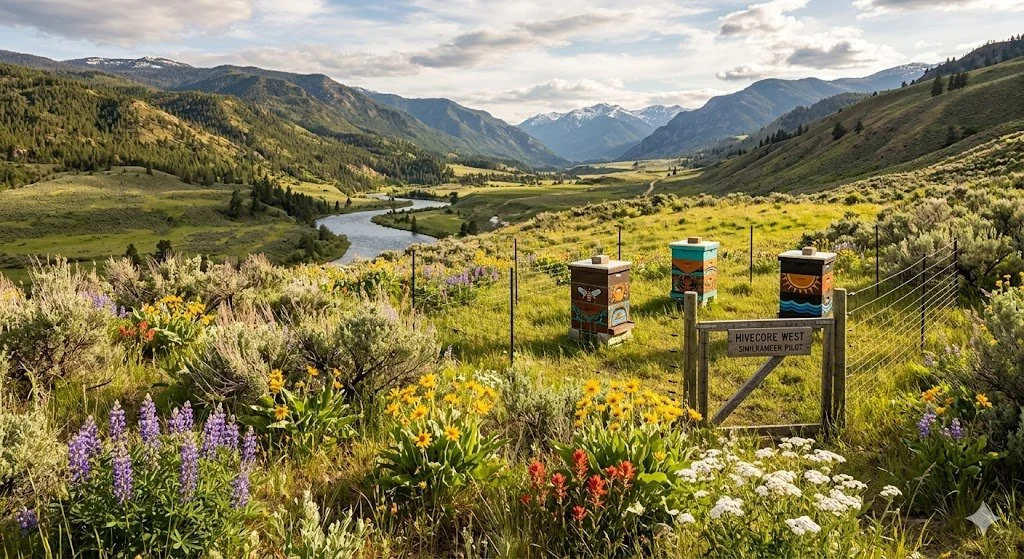
Baseline Calibration: Our current Similkameen Pilot in Princeton, BC, provides the "Regional Baseline" data. We don't just measure your site; we compare it to the natural "Gold Standard" of the surrounding valley.
V. Call to Action: From Compliance to Vitality
The Ministry and your stakeholders are looking for the next evolution in reclamation monitoring. Don't just tell them the trees are growing; show them the Biological Receipt.
For TechnicalFeasibility Studies: [Link: Book a Site Assessment]
For ESG Reporting Frameworks: [Link: Download the Sentinel Protocol White Paper]
Connect with Logistics: [Link: Inquiry for Site Deployment]