

Sentinel Protocol: The Definitive Standard for Nature-Validated Proof
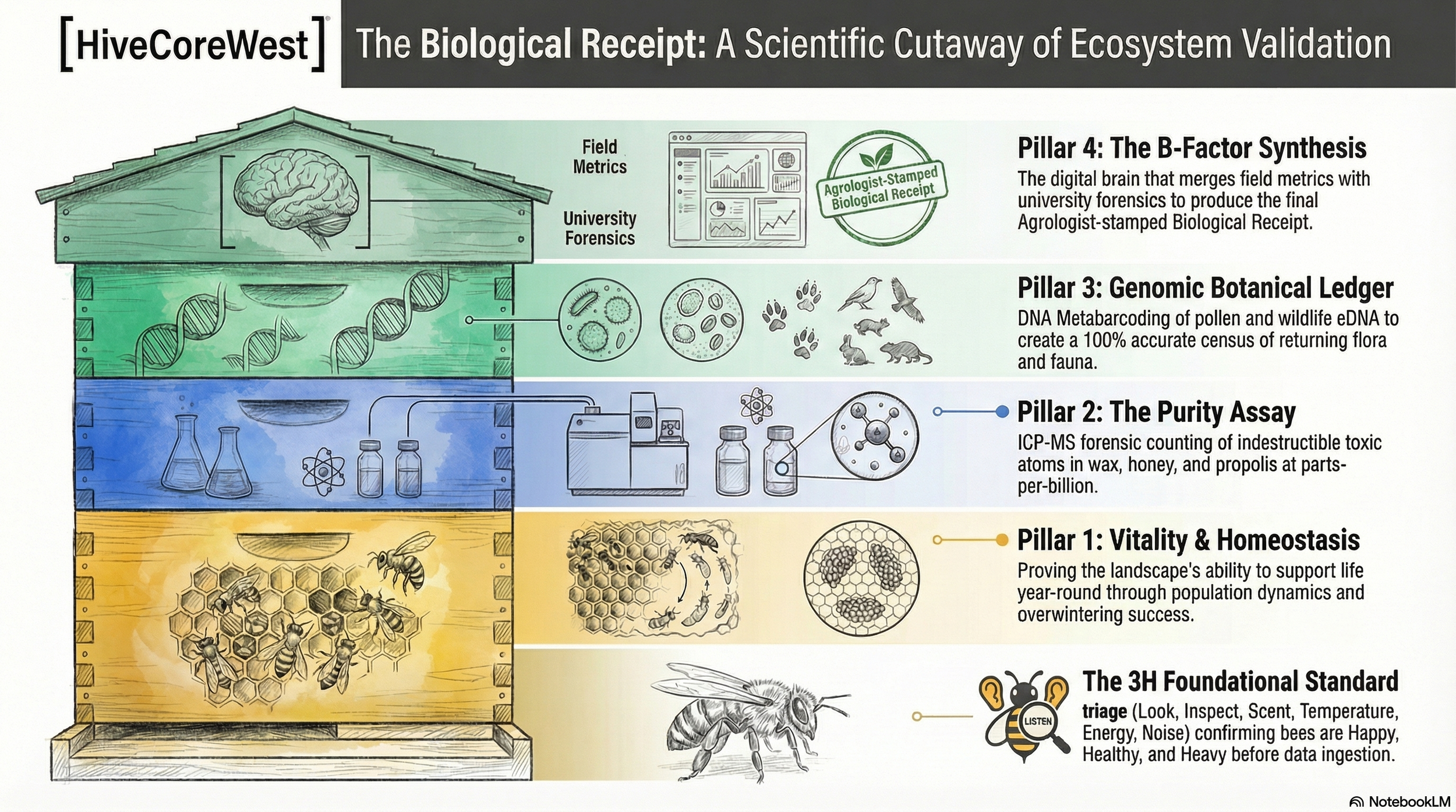
The Biological Receipt: A Scientific Cutaway of Ecosystem Validation" by [Logo: HiveCoreWest]. The image features a professional hand-drawn technical sketch of a beehive cross-section, with each level representing a different stage of environmental auditing: Pillar 4 B-Factor Synthesis (Digital Brain), Pillar 3 Genomic Botanical Ledger (DNA and wildlife eDNA), Pillar 2 Purity Assay (ICP-MS chemical testing), and Pillar 1 Vitality (Population Dynamics). The base highlights the 3H Foundational Standard (Happy, Healthy, Heavy) and the LISTEN triage methodology
The "Living" Problem: An Introduction
For environmental managers overseeing reclaimed industrial sites, the primary challenge is moving beyond surface-level appearances. While a site may appear stabilized, the true measure of success lies in whether the ecosystem has transitioned into a functional, inhabited state. Legacy methodologies often struggle to penetrate the opaque boundary between surface stability and true ecological function.
HiveCoreWest addresses this gap by providing "Living Indicators for Working Landscapes." By utilizing a 2,800-hectare biological lens, we transform active land reclamation into a quantifiable, boardroom-ready narrative. This approach provides corporate stakeholders with a high-resolution validation layer, proving that environmental efforts are sustaining complex, sensitive biological systems.
The 3,000-Hectare Biological Radar
Traditional environmental surveys are limited by human reach and static sampling points. : HiveCoreWest replaces these slow, subjective human botanical surveys with a Sentinel Apiary—a strategically placed biological hub. Using locally adapted honeybees as "high-tech auditors," we deploy tens of thousands of mobile agents that interact with millions of data points daily across a 3-kilometer radius.
A critical component of this forensic audit is the Scientific Anchor. To verify reclamation success, we establish a Pristine Control Site in an undisturbed ecosystem outside the industrial radius. This provides the necessary natural baseline; if the Sentinel Apiary on the reclaimed land matches the biological rhythm of the pristine valley, we have undeniable proof of ecological recovery.
"We utilize nature’s most efficient, high-tech auditors—locally adapted honeybees—to continuously monitor a 2,800-hectare radius, translating complex ecological functions into quantifiable, boardroom-ready data."
Pillar 1: Vitality — Thermodynamic Proof & The 35°C Standard
The foundation of the HiveCoreWest audit is Pillar 1: Vitality. This phase provides the baseline evidence that the reclaimed landscape is physically capable of sustaining complex life across the full "four-season crucible." Before we analyze DNA or chemical purity, we must first prove the land can power a biological engine.
To verify this, we utilize the LISTEN triage methodology to calibrate our biological assets against the 3H Standard: Happy, Healthy, and Heavy.
The LISTEN Methodology: Non-Invasive Triage
Think of the LISTEN protocol as a "biological handshake." It allows our team to perform a high-fidelity vitals check without opening the hive or disrupting the data collection process. We use specialized tools—including veterinary stethoscopes and infrared sensors—to monitor:
Look & Inspect: Monitoring "foraging flux"—the speed and volume of bees entering the hive.
Scent: Detecting Volatile Organic Compounds (VOCs) that signal hive health or stress.
Temperature & Energy: Measuring the internal thermal output and mass delta (weight changes).
Noise: Analyzing the frequency of the colony's collective hum.
The 3H Standard: The Vitality Metrics
H1: Happy (Neuroethological Stability) In forensic auditing, an unbiased sampler is critical. "Happy" refers to Acoustic Steady-State. Using bio-acoustic frequency analysis, we verify that the colony is in a calm, productive state (typically between 150–250 Hz). If a colony is stressed or "agitated," their foraging behavior changes, which would skew our environmental samples. We ensure our auditors are neuroethologically stable to provide the most accurate data possible.
H2: Healthy (Thermodynamic Stability) This is the "Biological Furnace" metric. A functional colony must maintain a consistent internal core temperature of 35°C (95°F), regardless of external weather. This is a non-negotiable physiological requirement for brood rearing and colony survival. We use infrared thermal mapping to confirm this steady state, proving that the bees have the physiological resilience to regulate their environment within the reclaimed landscape.
H3: Heavy (Caloric Stability) "Heavy" is our proxy for Net Primary Productivity (NPP). By using precision digital crane scales, we track the "Mass Delta"—the daily change in hive weight. A "Heavy" hive confirms a caloric surplus; it proves that the reclaimed land is providing a massive abundance of nectar and pollen. If the hive isn't gaining weight, the land isn't functioning.
The Ultimate Trial: The Winter Crucible
The true test of Pillar 1 is the ability to maintain the 35°C Standard through a sub-zero winter. Because honeybees do not hibernate, they must vibrate their wing muscles to generate heat for months on end.
This requires a massive amount of "clean fuel." Maintaining that 35°C core when it is -30°C outside is the ultimate Thermodynamic Proof. It verifies that the reclaimed land yielded enough high-quality caloric energy during the summer to power the biological furnace year-round. If the colony emerges in the spring "Healthy and Heavy," the land has passed its first forensic test: it is officially capable of sustaining life.
Pillar 2: The Purity Assay — Forensic Purity in Parts-Per-Billion
Once vitality is established, we transition to Pillar 2: The Purity Assay. This phase provides the molecular proof that the life on-site is chemically safe and that legacy industrial materials are not translocating into the biological food web.
Following the Honeybee Directive, we move beyond simple soil and water testing. We utilize the hive as a sophisticated filtration system, sampling the bees themselves along with three distinct hive matrices that act as "micro-particulate collection agents." This allows HiveCoreWest to perform a multi-dimensional chemical audit:
The Biological Audit (The Honey Bee): We analyze the bees themselves for bio-accumulation. As the primary auditors, their physiological health is the first line of evidence that the reclaimed landscape is not transferring toxins into higher life forms.
The Lipophilic Audit (Wax): Think of wax as the hive’s "long-term memory." Because wax is lipophilic (fat-loving), it acts as a permanent chemical sponge. It is uniquely capable of trapping and holding oil-based compounds, hydrocarbons, and industrial solvents that traditional air or water tests might miss.
The Resin Archive (Propolis): Propolis is the antimicrobial "glue" bees harvest from tree resins. Because trees draw nutrients and water from deep within the soil profile, propolis serves as a long-term resin archive. It provides a forensic record of both deep-soil health and the atmospheric dust that settles on the trees.
The Hydrophilic Audit (Honey/Nectar): This is our "liquid audit." Because nectar is hydrophilic (water-loving), it acts as a direct proxy for groundwater and soil solubility. It reveals any soluble heavy metals or chemicals that plants have drawn up through their root systems from the water table.
illustrating how wax traps oil-based compounds and nectar captures water-soluble contaminants]
The Atomic Count: ICP-MS Resolution
All samples undergo Inductively Coupled Plasma Mass Spectrometry (ICP-MS). In simple educational terms, we vaporize these biological samples in a plasma fire hotter than the sun to count individual toxic atoms one by one.
This process achieves a resolution of parts-per-billion (ppb). To visualize this level of precision: it is equivalent to finding a single drop of ink diluted into an entire Olympic-sized swimming pool. By cross-referencing these results against our Pristine Control Site, HiveCoreWestprovides forensic proof that subsurface liabilities remain safely contained and that the ecosystem is chemically pristine.
The Biological Receipt: A Scientific Cutaway of Ecosystem Validation" by [Logo: HiveCoreWest]. The image features a professional hand-drawn technical sketch of a beehive cross-section, with each level representing a different stage of environmental auditing: Pillar 4 B-Factor Synthesis (Digital Brain), Pillar 3 Genomic Botanical Ledger (DNA and wildlife eDNA), Pillar 2 Purity Assay (ICP-MS chemical testing), and Pillar 1 Vitality (Population Dynamics). The base highlights the 3H Foundational Standard (Happy, Healthy, Heavy) and the LISTEN triage methodology
Pillar 3: The Genomic Ledger
Provides the definitive mathematical proof of biodiversity. While visual surveys are limited by human subjectivity and physical reach, [Logo: HiveCoreWest] utilizes molecular forensics to identify the exact genetic signature of every blooming plant and returning animal within a 2,800-hectare radius.
This "CSI for nature" process allows us to create a high-resolution census of the landscape. We don't just identify trees; we sequence the Environmental DNA (eDNA)—the "genetic shadow"—of vertebrates like bears, elk, and migratory birds that interact with the bees or the water sources on-site. This forensic journey follows four cinematic laboratory stages:
1. Cell Lysis: "Cracking the Vault"
Every grain of pollen is protected by an "exine"—an armored shell so durable it can survive for millions of years. This is the microscopic "safe" that holds the plant's genetic code. In the lab, we perform Cell Lysis, using a combination of physical bead-beating and chemical buffers to "crack the vault." By breaking these armored shells, we release the raw DNA into a solution, making the ecosystem’s history accessible for the first time.
2. PCR Amplification: "The Molecular Photocopier"
Often, the amount of DNA recovered from a sample is too small for modern sequencers to "read" accurately. We solve this using Polymerase Chain Reaction (PCR), or what we call the Molecular Photocopier. We take a single genetic "receipt" found in the pollen or eDNA and print one billion perfect copies. This amplification ensures that even the rarest native plant or a single passing animal leaves a genetic signal loud enough to be captured by the sensors.
3. High-Throughput Sequencing: "The Supermarket Scanner"
Once the DNA is amplified, it enters the High-Throughput Sequencer. Think of this as a high-speed Supermarket Scanner. The machine reads the unique "barcodes" (specific genetic sequences like 12S rRNA for animals or ITS for plants) of every species in the sample simultaneously. It doesn't just look for one thing; it reads millions of strands of DNA at once, providing a massive, unfiltered data dump of every living organism that touched the 2,800-hectare audit zone.
4. Bioinformatics: "The Digital Library"
The final stage is Bioinformatics, where we take those millions of raw barcodes and run them through a Global Digital Library. By matching the lab results against established genetic databases, we can identify native flora, invasive species, and returning wildlife with 100% accuracy. This transition from "raw data" to "species list" is what creates the Botanical and Wildlife Ledger.
"We go from a pellet of dust to a definitive, mathematically proven catalog of life."
By the end of Pillar 3, HiveCoreWesthas provided more than just a list; we have provided the Genomic Proof of Biodiversity Net Gain (BNG). This is the level of certainty required for modern ESG reporting and authentic stakeholder engagement.
Pillar 4: The B-Factor — The Synthesis Engine & The Biological Receipt
Pillar 4: The B-Factor is the proprietary "Digital Brain" of the HiveCoreWest framework. While the first three pillars provide the raw data—Vitality (physical), Purity (chemical), and Genomics (biological)—the B-Factor is the intelligence layer that synthesizes these isolated streams into a single, high-resolution validation of ecosystem success.
The Intelligence Engine: Multivariate Data Fusion
In simple educational terms, the B-Factor is our "Intelligence Engine." It utilizes Multivariate Ecological Data Fusion to cross-reference every data point collected over the 12-month audit. It doesn't just look at the list of plants (Pillar 3) or the chemical safety (Pillar 2) in isolation. Instead, it asks: Is the returning flora actually supporting the returning fauna? By analyzing the "Trophic Correlation"—the way energy moves from the soil to the plants and then to the animals—the B-Factor provides the definitive proof of Trophic Integrity. It confirms that the reclaimed landscape isn't just a collection of species, but a functional, interconnected food web.
The Trophic Correlation Audit: Proving the Food Web
The B-Factor performs a Trophic Correlation Audit. It takes the genetic shadow of the wildlife identified through eDNA (Pillar 3) and layers it over the chemical purity results (Pillar 2). This synthesis proves that the bears, elk, and birds returning to the site are foraging on clean, uncontaminated vegetation. This is the level of forensic certainty required to verify that a site has transitioned from a structural cover to a functional, inhabited ecosystem.
The Final Output: The Biological Receipt
The culmination of the B-Factor process is the generation of the Biological Receipt. This is not a standard environmental report; it is a forensic document designed for the boardroom and the community.
insignia]
The Biological Receipt transforms complex molecular forensics into an "Ecosystem Health Score" that provides:
Quantitative ESG Data: Hard evidence formatted for global sustainability reporting (GRI and SASB).
Stakeholder Assurance: Verifiable, nature-validated proof of health for local communities and regulatory bodies.
Professional Validation: Every Biological Receipt is reviewed and stamped by a Professional Agrologist (P.Ag). Think of this as the "Land Doctor’s" final signature, providing the ultimate professional endorsement of ecological return.
"The B-Factor turns environmental observations into forensic evidence."
By delivering a Biological Receipt, [Logo: HiveCoreWest] provides Environmental Managers with a high-fidelity "Report Card" that proves their reclamation success is not just estimated, but is scientifically verified and nature-validated.
The Biological Receipt: The New Corporate Standard
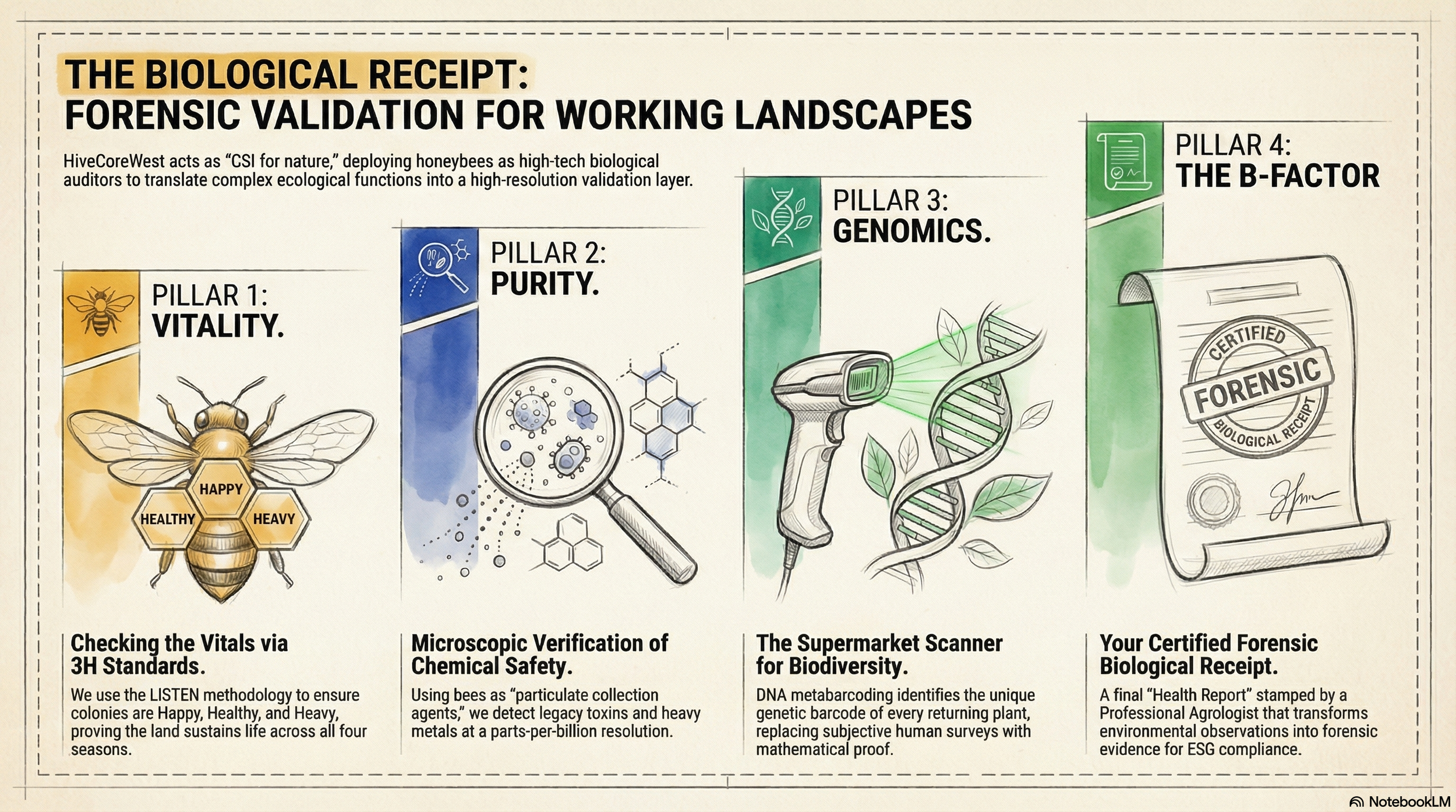
The final stage, Pillar 4: The B-Factor, is the digital synthesis engine that integrates data through "Multi-Vector Cross-Referencing." It fuses the Field Handshake (human ground-truth), the Logistics Trace (GPS-stamped chain of custody), and the Forensic Inflow (laboratory results).
[Visual: A technical pencil sketch with a vibrant emerald green wash showing a digital dashboard displaying an interconnected 3D web of wildlife and botanical DNA data.]
The result is a Biological Receipt, a forensic document that transforms observations into evidence:
ESG Compliance: Quantitative proof for GRI and SASB reporting.
Social Licence to Operate: A data-backed "Ecosystem Health Score" for community stakeholders.
Indigenous Stewardship: We honor the land by inviting Indigenous Elders to participate in formal Naming Ceremonies for overwintered hives.
The Land Doctor’s Approval: Every report is reviewed and stamped by a Professional Agrologist (P.Ag).
Conclusion: Beyond the Green Veneer
A truly functional ecosystem is defined by its capacity to support and sustain life. By moving beyond traditional visual checks and utilizing biological auditors, environmental managers can provide undeniable proof of ecological restoration.
The question for modern stakeholders is no longer just about coverage, but about function: Is your environmental data truly "alive," or is it simply a green veneer?
Integrate Sentinel Intelligence
#SentinelColonyProtocol #BiologicalReceipt #ForensicValidation #ESGProof #NatureValidated #AgrologistStamped #HiveCoreWest #EnvironmentalIntelligence
Pillar 1: Vitality & Field Methodology #3HStandard #LISTENMethodology #HappyHealthyHeavy #ThermodynamicProof #35DegreeStandard #BiologicalFurnace #MineReadiness #EcosystemVitality #EnvironmentalBaseline
Pillar 2: Purity & Chemical Forensics #ForensicPurity #ICPMS #PartsPerBillion #ChemicalSponge #PropolisArchive #AtomicCounting #EnvironmentalPurity #SubsurfaceValidation #BioAccumulationAudit
Pillar 3: Genomics & Biodiversity #GenomicLedger #DNAMetabarcoding #eDNA #WildlifeCensus #BotanicalIndex #CSIForNature #MolecularEcology #BiodiversityNetGain #NaturePositiveData #GeneticBarcode
Pillar 4: Synthesis & Compliance #TrophicIntegrity #EcosystemHealthScore #ESGCompliance #GRIReporting #SASBStandards #EnvironmentalReporting #DataCertainty #AgrologistStamped #ForensicEvidence
Community, Social License & Stewardship #SocialLicenceToOperate #IndigenousStewardship #CommunityTrust #LivingClassroom #SharedStewardship #EnvironmentalSocialGovernance #EcosystemRestoration
Industry & Professional #EnvironmentalManagement #MineReclamation #LandRestoration #SustainabilityStrategy #ProfessionalAgrologist #EcologicalRestoration #ESGStrategy #CorporateSustainability

Technical forensic schematic of a honeybee (Apis Mellifera) by [Logo: HiveCoreWest]. The detailed pencil sketch features architectural measurements and callouts for Wing Beat Frequency Analysis, Structural Load Vectors, and a Biomimetic Navigation Grid. Titled "The Sentinel Ecosystem Audit: High-Resolution Environmental Validation," the image represents the intersection of biological sensors and nature-validated molecular forensics.
Contact our team today to integrate the Sentinel Colony Protocol into your environmental strategy and secure your nature-validated Biological Receipt.