

The Biological Receipt - HiveCoreWest
Title: The Biological Receipt: Why Honeybees are the New Gold Standard for Environmental Validation
1. Introduction: The Corporate Accountability Gap
In the high-stakes arena of environmental, social, and governance (ESG) reporting, the gap between making a reclamation promise and providing forensic proof is widening. For decades, industries—particularly mining, energy, and heavy infrastructure—have relied on manual soil sampling and "drive-by" visual assessments to claim success.
But a landscape that looks green is not necessarily a landscape that works.
Enter "Living Indicators for Working Landscapes." To move beyond the limitations of static data, the industry is shifting toward biological validation. At the forefront of this movement is HiveCoreWest, a strategic partnership founded by Joshua Bandola (Director of Logistics) and Mark Vanderende (Master Beekeeper & Director of Living Systems). By bridging the gap between industrial-grade logistics and high-resolution biological expertise, they have transformed the honeybee into the ultimate environmental auditor.
2. Being "Mine Ready" is a Biological Prerequisite
The Pillar of Integration: Ensuring that biological systems are deployed with the same safety rigor as heavy industrial machinery.
For a biological system to provide value in a corporate context, it must first survive the environment it is meant to monitor. This requires "Zero-Friction Site Integration." HiveCoreWest does not simply "keep bees"; they deploy a "Logistics Shield." Every colony arrives "Mine Ready," fully compliant with Site-Specific Safety Plans (SSSP) and protected by industrial-grade infrastructure, including solar-powered bear fencing and standard Langstroth hives.
There is a powerful irony here: we are industrializing nature to save it. By treating a delicate biological organism with the same operational rigor as a multi-ton excavator, HiveCoreWest removes the friction of corporate adoption. For an environmental audit to be defensible in a boardroom, the tools must be as resilient as the industry they are monitoring.
3. The "Bouncer with a Clicker" and the 3H Standard
The Pillar of Calibration: Using a non-invasive triage to ensure the biological sensors are functional before the audit begins.
Before the data collection starts, the sensors must be calibrated. HiveCoreWest utilizes the "Handshake" phase, employing a proprietary LISTEN triage. This isn’t just a visual check; it’s a technical assessment of "Foraging Flux"—measuring acoustic frequency and mass delta to ensure the colony is optimized. This process ensures every hive meets the 3H Standard:
Happy: Calm, non-aggressive behavior.
Healthy: Warm internal core temperature.
Heavy: Productive, with sufficient honey reserves.
Checking the foraging flux is more than a health check; it is the calibration of a high-resolution sensor. If the "bouncer" (the hive entrance) shows a steady, rhythmic flow of traffic, the sensor is online and ready to archive the environment.
4. The 35°C Standard—A Thermodynamic Proof of Life
Pillar 1: Vitality: Using internal hive temperature as a binary forensic metric for landscape functionality.
In the world of forensic ecology, thermodynamics do not lie. A healthy honeybee colony must maintain a consistent internal core of 35°C to survive. This requirement creates what HiveCoreWest calls the "12-month winter crucible."
If a colony emerges from a winter cycle "Healthy and Heavy," it serves as thermodynamic proof that the surrounding land provided enough "clean fuel" (nectar and pollen) to power the biological furnace year-round. This 35°C standard is a binary metric: the land is either functional enough to sustain life, or it isn't. It is the most honest receipt an ecosystem can sign.
5. Atomic Counting and the "Chemical Sponge"
Pillar 2: Purity: Utilizing high-accuracy mass spectrometry to detect environmental contaminants at the molecular level.
Honeybees are "micro-archivists" that function as a "Chemical Sponge." As they forage, they sample every corner of the landscape, bringing back a chemical signature of the soil, water, and air. HiveCoreWest utilizes Inductively Coupled Plasma Mass Spectrometry (ICP-MS) to count individual atoms in parts-per-billion (ppb), specifically tracking hydrocarbons and heavy metals.
To provide a 360-degree forensic map, the protocol analyzes four distinct matrices:
The Bee: A living "static vacuum" that captures current environmental exposure and bio-availability.
Wax: Acts as a long-term archive for fat-soluble compounds and hydrocarbons.
Pollen: Provides a microscopic cross-section of atmospheric air quality and topsoil stability.
Nectar: Offers an immediate chemical signature of groundwater purity expressed through local flora.
6. DNA Barcoding the "Wildlife Shadow"
Pillar 3: Genomics: Creating a 100% accurate census of biodiversity using genetic blueprints and environmental DNA.
While chemistry proves safety, genomics proves diversity. HiveCoreWest uses two distinct genetic tools to audit the landscape:
Pollen Barcoding: Every grain of pollen is a "genetic blueprint." By sequencing this pollen, they identify every plant species present in the area.
eDNA (Environmental DNA): This acts as a "wildlife shadow." By analyzing the DNA traces left behind, HiveCoreWest can track the return of mammals and birds.
This creates a 100% accurate census of every plant and animal within a 2,800-hectare radius. In a world of "estimated" biodiversity, this provides a hard data set that replaces guesswork with genetic certainty.
7. The B-Factor and the Synthesis of Trophic Integrity
Pillar 4: The B-Factor: Fusing field metrics, chemistry, and DNA into a single intelligence engine.
The "B-Factor" is the "Digital Brain" of the Sentinel Protocol. It is where the three previous gears—Vitality, Purity, and Genomics—turn together to power a central conclusion. This synthesis moves beyond isolated data points to prove Trophic Integrity.
Trophic Integrity is the verification that the ecosystem is a complete, connected web rather than a collection of isolated parts. The final deliverable is the "Biological Receipt": an ESG-ready, forensic document stamped by a Professional Agrologist (P.Ag). For a modern boardroom, this is the ultimate proof of success—a scientifically unassailable validation that the land has returned to functional health.
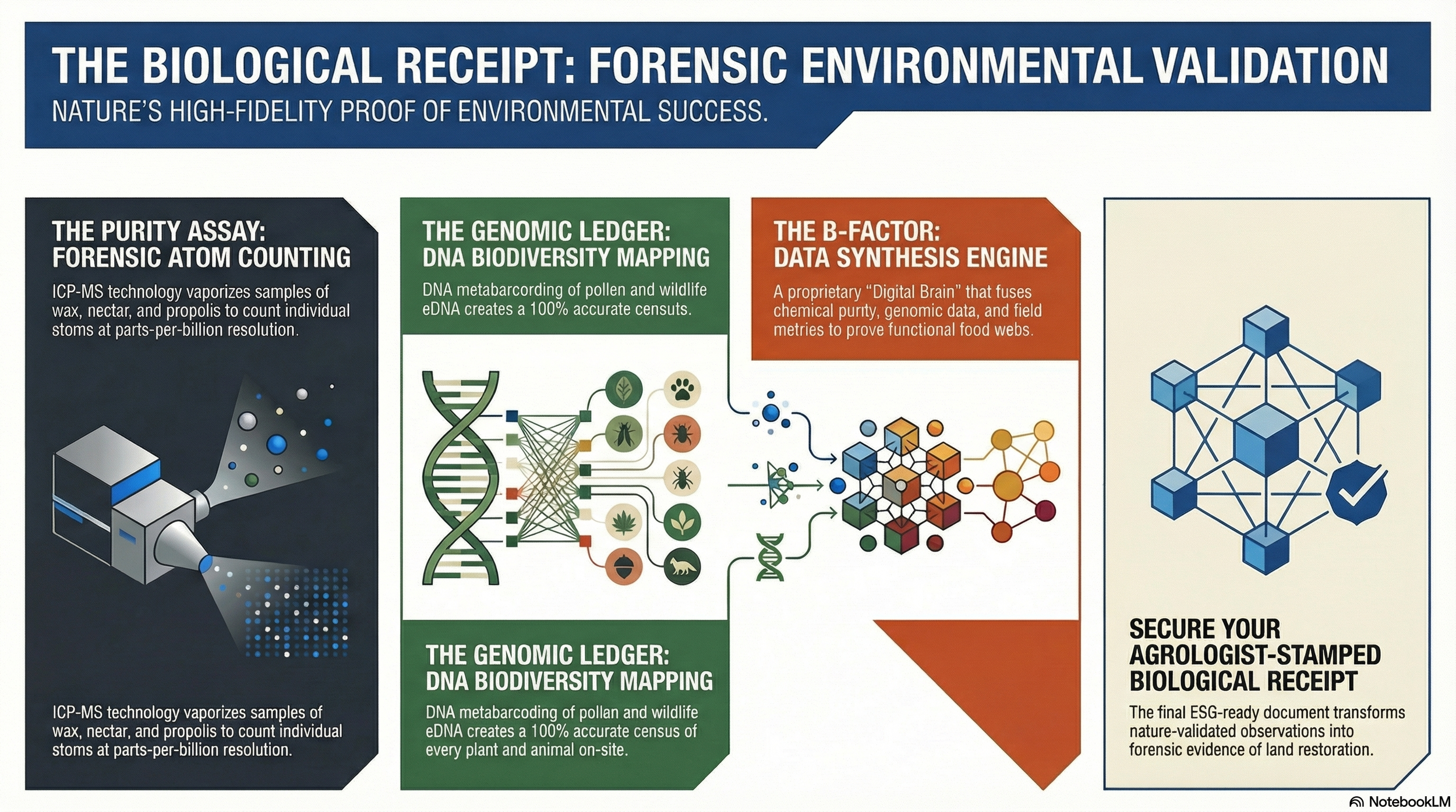
Pillar ImageOptimized Alt TextPillar 1: VitalityHoneybee hive thermal monitoring at a mine reclamation site showing the 35°C core temperature standard for ecosystem vitality.Pillar 2: PurityMicroscopic lab analysis of honeybee bio-matrices using ICP-MS to detect heavy metals and chemical purity in reclaimed landscapes.Pillar 3: GenomicsDNA metabarcoding and pollen sequencing graphics showing a 100% accurate biodiversity census and wildlife shadow on industrial land.Pillar 4: B-FactorThe B-Factor digital engine synthesizing field data and agrologist-stamped biological receipts for corporate ESG reporting.
8. Stewardship—Where Science Meets Social License
The Human Pillar: Building community trust and transparency by making scientific data visible and culturally resonant.
Data alone cannot buy "Social License to Operate." HiveCoreWest understands that for reclamation to be successful, it must be embraced by the local community. They integrate "Shared Stewardship" to bridge the gap between the scientist and the stakeholder through:
Indigenous Naming Ceremonies: Honoring the land and the return of life through traditional protocols.
Living Classrooms: Providing hands-on mentorship for youth and Elders, turning the audit site into an educational hub.
Painted Boxes: Community-painted hives turn technical gear into a point of local pride.
By making the science "visible" through art and mentorship, HiveCoreWest builds a level of transparency and trust that a spreadsheet could never achieve.
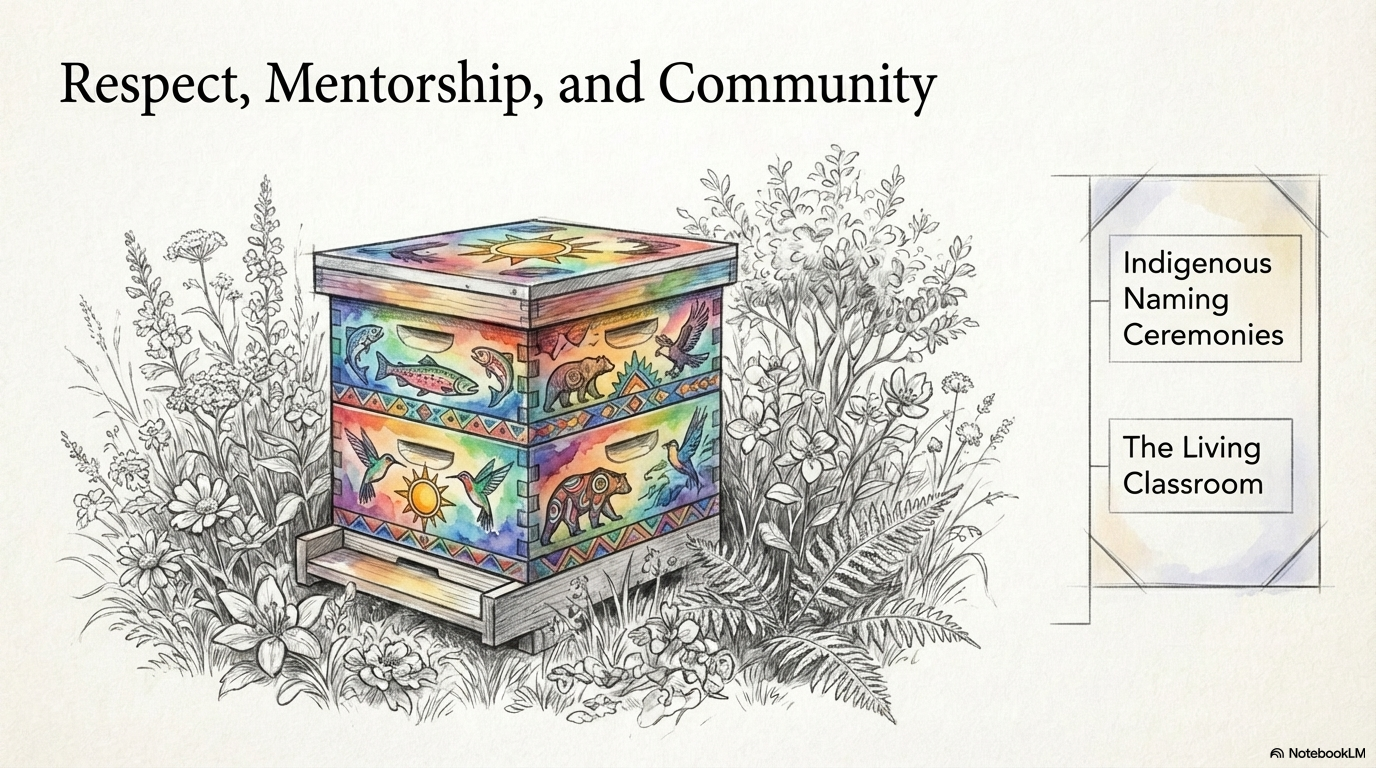
A pencil-sketch illustration of a traditional Langstroth beehive vividly painted with Indigenous-style art featuring bears, salmon, hummingbirds, and sun motifs. The hive is set in a meadow of wildflowers and ferns, accompanied by a diagram highlighting 'Indigenous Naming Ceremonies' and 'The Living Classroom' as part of HiveCoreWest’s community stewardship pilla
9. Conclusion: A New Era of Environmental Evidence
We are entering an era where "good intentions" are no longer a viable corporate strategy. Stakeholders, regulators, and communities are demanding high-resolution proof of environmental success. HiveCoreWest provides the transition from guessing to validating, offering a system where biological precision meets industrial logistics.
As we look toward the future of sustainable innovation, a single question remains for the modern leader: In an era of greenwashing, will you continue to rely on a spreadsheet, or will you demand a Biological Receipt signed by the land itself? Why Honeybees are the New Gold Standard for Environmental Validation

A professional closing slide titled 'Let’s Validate Your Success Together' featuring the HiveCoreWest hexagonal logo in a watercolor pencil-sketch style. Below the logo, the names and titles of the founders are listed: Joshua Bandola, Director of Logistics, and Mark Vanderende, Director of Living Systems, presented on a clean, textured off-white background.