

Beyond the Snapshot: How Honeybees are Becoming the World’s Most High-Tech Environmental Auditors
Gemini said
A hand-drawn colored pencil sketch on textured paper, depicting a stack of four standard wooden beehive boxes (a Langstroth hive) monitored as a biological auditor by HiveCoreWest on reclaimed industrial land. The hive sits on a stone slab nestled in green foliage and blooming wildflowers (pollen and nectar source). The foreground ground is earth-toned. In the far background landscape, a large, tiered industrial facility with processing towers and nearby power pylons is sketched, illustrating the placement of an apiary within its monitoring radius on a mine site. The style is an organic field sketch with visible pencil strokes.
Beyond the Snapshot: How Honeybees are Becoming the World’s Most High-Tech Environmental Auditors
1. Introduction: The Ghost of Reclamation Past
For heavy industry, the ambition to prove that a landscape has truly returned to health has long faced a technical bottleneck. Traditionally, environmental success is measured through "static snapshots"—isolated soil and water samples that capture a single moment in time but struggle to convey the vitality of a whole ecosystem. There is a persistent, relatably human curiosity at play here: is the land truly healing, or is it merely appearing stable for the auditors? HiveCoreWest has introduced a visionary shift in this paradigm by offering what they call the "Biological Receipt." It is a move away from dead data toward a living, breathing report card that uses nature’s own systems to verify environmental integrity.
2. Nature’s Ultimate Auditors: The 3-Kilometer Living Radius
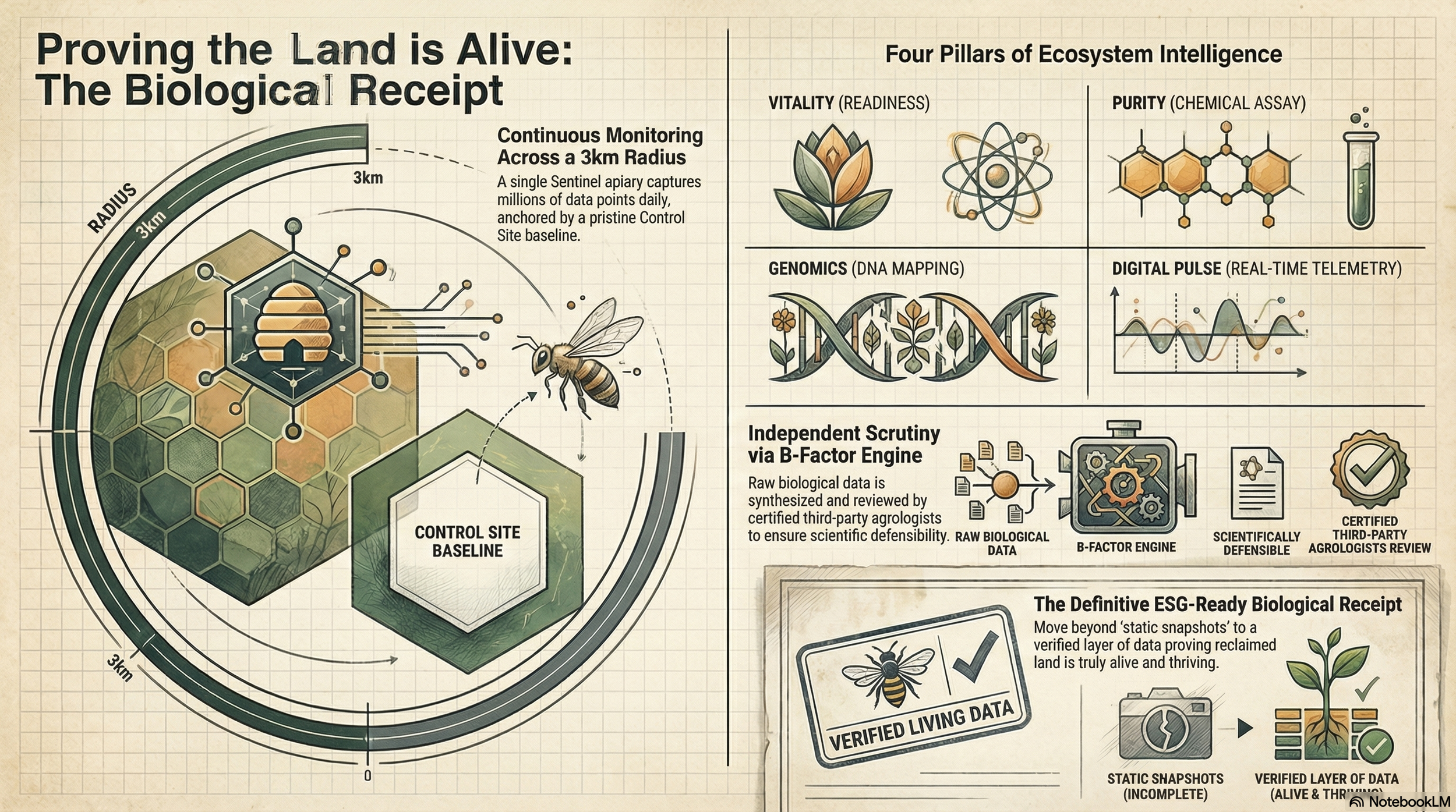
The core of this innovation lies in the use of "Sentinel Apiaries"—biological monitoring stations powered by locally adapted honeybees. These are not merely hives; they are high-tech data collection hubs. While a traditional spot test might represent a single square meter, a honeybee colony continuously assesses the environment across a massive 3-kilometer radius.
This scale offers a far more representative view of an ecosystem than spot-testing ever could. It creates a constant, living stream of environmental data gathered directly from the working landscape. As the source context describes:
"A single sentinel apiary system acts as a biological monitoring station and it's continuously assessing the health of a huge 3 km radius... It's a constant living stream of environmental data coming right from the heart of your working landscape."
3. The Science of Integrity: Why the "Control Site" is Non-Negotiable
To ensure that biological data is scientifically unimpeachable and defendable in the boardroom, HiveCoreWest utilizes a dual-site anchor system. The "Project Site" is situated on the healing industrial land, while the "Control Site" is placed in a pristine, undisturbed native forest ecosystem entirely outside the project’s influence.
By comparing the two, HiveCoreWest establishes a "perfect natural baseline." This allows for the precise measurement of "gap closure" between industrial reclamation and natural purity. It establishes a chemical and genetic ceiling that provides stakeholders with a clear, defendable metric of how close a site is to reaching its full ecological potential.
4. The 3H Standard: Happy, Healthy, and Heavy
The health of the bee is the essential prerequisite for accurate data collection; only thriving bees can provide high-fidelity environmental intelligence. This biological foundation is maintained through the "LISTEN Methodology," a sensory-driven, non-disruptive operating system that allows specialists to read the invisible health of a landscape through the hum and weight of the hive.
Under the LISTEN methodology, every colony must meet the mandatory 3H Standard:
Happy: Ensuring harmonious integration with the local ecosystem.
Healthy: Maintaining robust immune function and colony vitality.
Heavy: Verifying strong foraging success and resource accumulation.
5. Foundational Pillars: Vitality and Purity
The data generated by HiveCoreWest is built on four distinct pillars. The first two establish the baseline of safety and chemical integrity.
Pillar 1: Vitality & Industrial Readiness: This is a comprehensive 12-month foundational phase involving "boots-on-the-ground" mapping to ensure the land can sustain the auditors. HiveCoreWest integrates seamlessly with industrial operations, utilizing robust bear fencing for asset security and complying with all Site-Specific Safety Plans (SSSP) and PPE requirements to access active mine sites without disrupting operations.
Pillar 2: The Purity Assay: Honeybees interact with the environment at a microscopic level, making them ideal sample collectors. Through partnerships with specialized third-party labs, HiveCoreWest utilizes rigorous ICP-MS (Inductively Coupled Plasma Mass Spectrometry) testing. By analyzing the bees, nectar, honey, propolis, and wax, they generate a precise "parts-per-billion" chemical signature of the landscape, providing defensible proof of soil and water safety.
6. Advanced Intelligence: Genomics and the Digital Pulse
The final two pillars bring the project into the realm of forensic science and real-time "Executive Intelligence."
Pillar 3: The Genomic Ledger: As bees forage, they gather massive volumes of pollen. Using advanced DNA Metabarcoding, this pollen is sequenced to create a "living ledger." This moves beyond casual botanical surveys to forensic-level genetic certainty, proving exactly which plant species are thriving across the restored canopy.
Pillar 4: The 24/7 Digital Pulse: Every hive is equipped with remote IoT sensors tracking the thermal core, acoustic vibrations, and weight in real-time. Field scouts use unique QR codes on the hives for instant data access. This provides "zero-friction integration" for the client, who can monitor ecosystem performance 24/7 through a transparent dashboard.
7. The Biological Receipt: Closing the Gap on ESG Reporting
The synthesis of these four streams—Vitality, Purity, Genomics, and the Digital Pulse—is managed by the "B-Factor Engine." This proprietary central brain calculates the data, which is then subjected to a strict, independent review by certified Agrologists. This final layer of professional scrutiny ensures the data is scientifically robust and ready for the highest levels of corporate disclosure.
The resulting "Biological Receipt" is the ultimate deliverable for Environmental, Social, and Governance (ESG) reporting.
"The Biological Receipt... is the ultimate deliverable. It’s an undeniable report totally ready for your environmental, social, and governance, your ESG disclosures. It gives you a verified layer of data that proves your reclaimed land isn't just stable, it's truly alive."
8. Legacy Beyond Data: The Social License to Operate
While the hard science is essential, HiveCoreWest recognizes that a "Social License to Operate" requires genuine human connection. They weave their operations into the local community to forge a lasting legacy. This includes inviting local youth to paint apiary boxes and name the sites, providing hands-on mentorship, and working in deep partnership with local Indigenous Elders. By honoring the traditional stewards of the land and fostering intergenerational connections, they ensure that the science is paired with a meaningful social impact.
9. Conclusion: Is Your Proof Truly Alive?
HiveCoreWest, led by co-founders Joshua Bandola (Director of Logistics) and Mark Vanderende (Director of Living Systems and Master Beekeeper), is setting a new verification standard at the intersection of deep ecology and modern industry. Their approach offers a way to verify environmental success from the inside out, turning the landscape itself into a partner in the reclamation process.
As industry leadership moves toward higher transparency, the critical question for every decision-maker remains: When you report on your environmental success, can you say with absolute certainty that your proof is truly alive?
To learn more about adding this ultimate layer of verification to your reclamation efforts, visit HiveCoreWest.com.