

Molecular Auditing: The Triad of Forensic Evidence in Industrial Biomonitoring
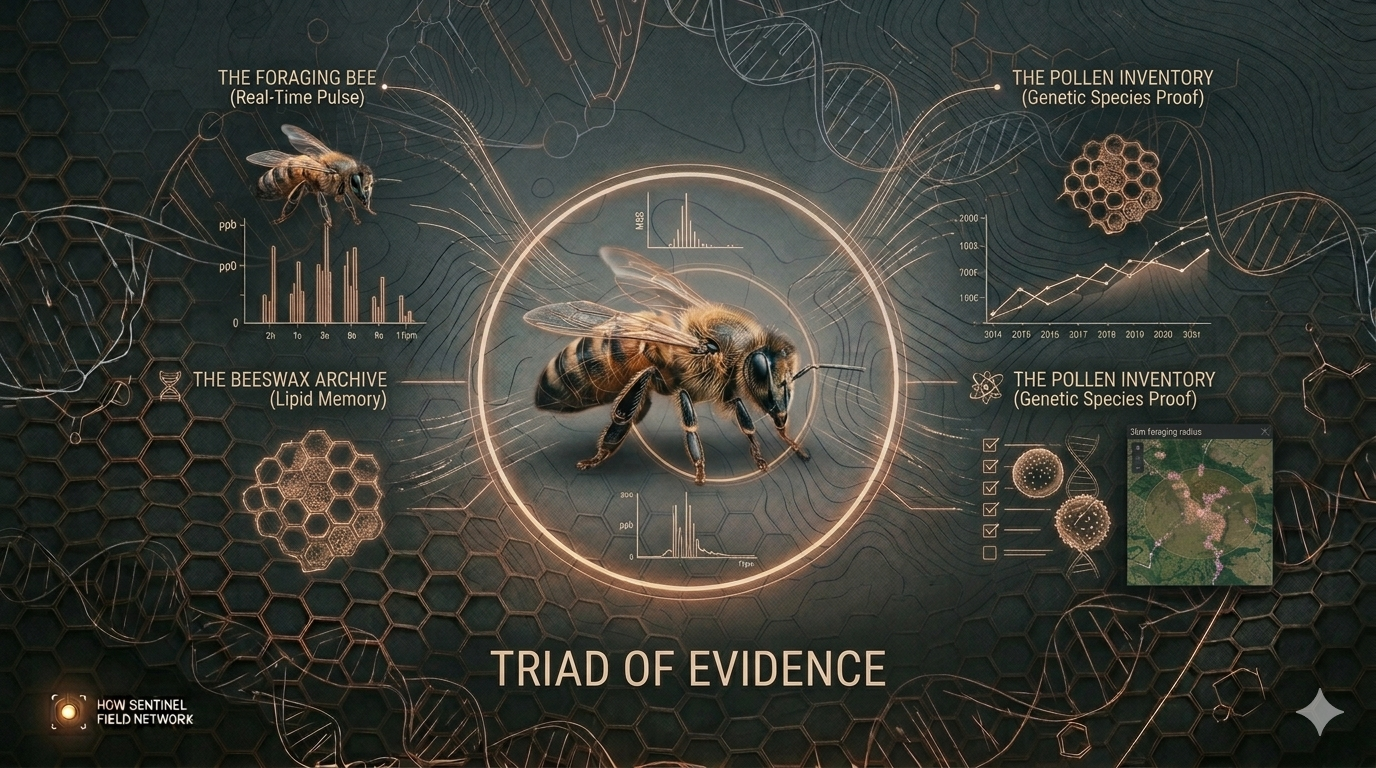
Scientific visualization of ICP-MS sampling matrices, showing a honeybee, hexagonal beeswax cells, and magnified pollen grains interconnected by copper data streams and parts-per-billion (ppb) graphs.
Executive Summary: The Architecture of Discovery
In industrial land reclamation, the primary challenge is not just detecting a contaminant, but identifying its origin. Knowing a heavy metal exists on-site is only half the battle; knowing how it is moving through the environment is the key to regulatory defense and site closure. At HiveCoreWest, we utilize Inductively Coupled Plasma Mass Spectrometry (ICP-MS) to audit three distinct biological matrices: the Foraging Bee, the Propolis, and the Beeswax. By cross-referencing these data streams, we create a 360-degree "Biological Receipt" that proves site integrity across air, soil, and water.
Chapter 1: The Foraging Bee – The Acute, Real-Time Pulse
The honeybee herself is our most active field sensor. During the foraging season, a single worker bee interacts with thousands of individual flowers and water sources within her 3km foraging radius. When we perform an ICP-MS audit on the bees themselves, we are capturing Acute Exposure Data.
Because the honeybee has a rapid metabolic cycle and a lifespan of only a few weeks during the summer, the trace elements found in her system represent the "Right Now" of your project site. This data acts as a real-time pulse. It tells us what is currently circulating in the ecosystem’s vascular system—the nectar and the groundwater. If we detect a spike in the bee, we know there is an immediate, mobile source of a contaminant that requires intervention. This is the "Front-Line" indicator of the Sentinel Network.
Chapter 2: Propolis – The Atmospheric Audit
Propolis is a complex, resinous substance collected by bees from the buds of trees (primarily poplars, birches, and conifers). In the hive, bees use it as a structural sealant and an antimicrobial "immune system." In environmental forensics, however, propolis is a high-fidelity Atmospheric Recorder.
Because these resins are exposed on the exterior of trees before being gathered, they act as biological "flypaper." They capture wind-borne particulate matter, tailings dust, and stack emissions that settle on the bark and buds. By auditing the Propolis via ICP-MS, HiveCoreWest can differentiate between soil-based contaminants and Atmospheric Deposition.
The Strategic Value: If the Propolis shows high levels of heavy metals while the honey and beeswax remain clean, we can definitively prove to regulators that the issue is air quality or wind-blown dust from a neighboring source, rather than a failure of the internal soil reclamation strategy.
Chapter 3: Beeswax – The Multi-Year Chemical Archive
Beeswax is the structural foundation of the hive, but to an environmental scientist, it is a Lipid-Based Memory. Unlike honey (which is transient and consumed) or the bee (which has a short lifespan), beeswax is a permanent fixture of the colony that accumulates environmental signatures over several seasons.
Many of the most concerning industrial contaminants—including heavy metals like Lead and Mercury, as well as certain hydrocarbons—are lipophilic. This means they bind aggressively to fats and waxes. As the bees process resources and build the comb, these trace elements become locked into the wax scales.
ICP-MS analysis of the wax provides the Legacy Data of the site. It allows HiveCoreWest to perform a "Trend Analysis" over several years. We use this to prove that contaminant levels are decreasing as the reclamation matures. This is your primary evidence for long-term site stability and the final "Stamp of Approval" for project closure.
Chapter 4: The HiveCoreWest Connection – Triangulating the Truth
The true power of HiveCoreWest isn't found in the individual lab reports; it is found in the Synthesis. We don't just hand you a spreadsheet of numbers; we provide the Expert Interpretation that connects these three matrices to your site’s specific geography.
We use a process called Forensic Triangulation:
Soil/Water Verification: If a metal spike appears in the Bee (Acute) and the Wax (Legacy) but is absent in the Propolis (Atmospheric), we can confirm the contaminant is being taken up through the Roots. This points to a soil or groundwater issue.
Air/Dust Verification: If the spike is only found in the Propolis, we know the vector is Wind. This allows the site manager to focus on dust suppression rather than expensive soil remediation.
This level of granularity allows site managers to make surgical adjustments to their plans, potentially saving millions in unnecessary broad-spectrum mitigation. We provide the "Social License to Operate" by replacing corporate guesswork with molecular, forensic certainty.
The Agrologist’s Perspective: The Professional Standard
From a professional agrology and environmental governance standpoint, this triad of evidence is the ultimate de-risking tool. It provides the empirical, third-party proof required to satisfy the most stringent regulatory audits. By documenting the transition from "Active Monitoring" to "Verified Recovery," HiveCoreWest paves a clear, data-backed path to final site release and the successful return of the land to the community.