

The Biological Receipt: Why Soil Samples Aren’t Enough for 2026 Reclamation
By Mark Vanderende & Joshua Bandola | Founders, HiveCoreWest
In the traditional world of heavy industry, success has long been measured by "static" compliance. We test the soil for pH. We monitor water run-off. We count how many saplings survived the season. While these metrics are necessary, they are incomplete. They tell us if a site is meeting a permit, but they do not tell us if the ecosystem is vital.
At HiveCoreWest, we are bridging this gap. We don’t just monitor land; we audit the life within it. We call this the Biological Receipt.
The Leadership: Biology Meets Logistics
A successful industrial deployment requires two distinct disciplines working in total synchronicity:
Mark Vanderende, Director of Living Systems: Bringing 30 years of Master Beekeeper experience, Mark oversees the biological integrity of our "Living Sensors." His LISTEN Methodology serves as the diagnostic framework that ensures our hives are tuned to the specific environmental frequencies of the landscape.
Joshua Bandola, Director of Logistics: Industrial sites are complex, high-risk environments. Joshua manages the operational deployment, bear-fencing protocols, and the logistical scaling required to maintain "Sentinel Hives" in rugged, active-industry locations like the Similkameen Valley.
The Sentinel Protocol: A 3km Diagnostic Radius
A honeybee colony is a dynamic, autonomous environmental auditor with a foraging radius of over 3 kilometers. Every day, tens of thousands of foragers interact with the local flora, water, and air. They return to the hive with the ground-truth data of the entire landscape.
Through our proprietary Sentinel Protocol, we utilize these sensors to provide real-time feedback on ecological recovery. By analyzing the hive’s internal rhythms and output, we can detect environmental stressors—chemical shifts or habitat fragmentation—long before they manifest in a lab-tested soil sample.
The 3H Standard: Defining Success in 2026
For HiveCoreWest, ecological success isn't an opinion; it's a measurable surplus. We look for the 3H Standard of Care:
Happy: Natural, low-stress behavioral rhythms—a direct reflection of the safety of the forage area.
Healthy: High reproductive vigor and immune resistance—the "Health Receipt" of the land’s chemical safety.
Heavy: This is the ultimate Biological Receipt. A heavy hive proves the land is providing a measurable surplus. If the bees can’t build a winter store, the reclamation has failed. If the hive is heavy, the land is alive.
Current Phase: The Similkameen Pilot (2026 Roadmap)
We are currently in the Baseline Phase of our 2026 roadmap. Our Similkameen Valley Pilot sites near Princeton, BC, are serving as our "Regional Control Group."
Before we audit a specific mine site, we must understand the "Regional Signature" of the surrounding untouched land. This allows us to offer industrial partners a comparative audit: Is your site approaching the vitality of the natural valley, or is there a biological deficit?
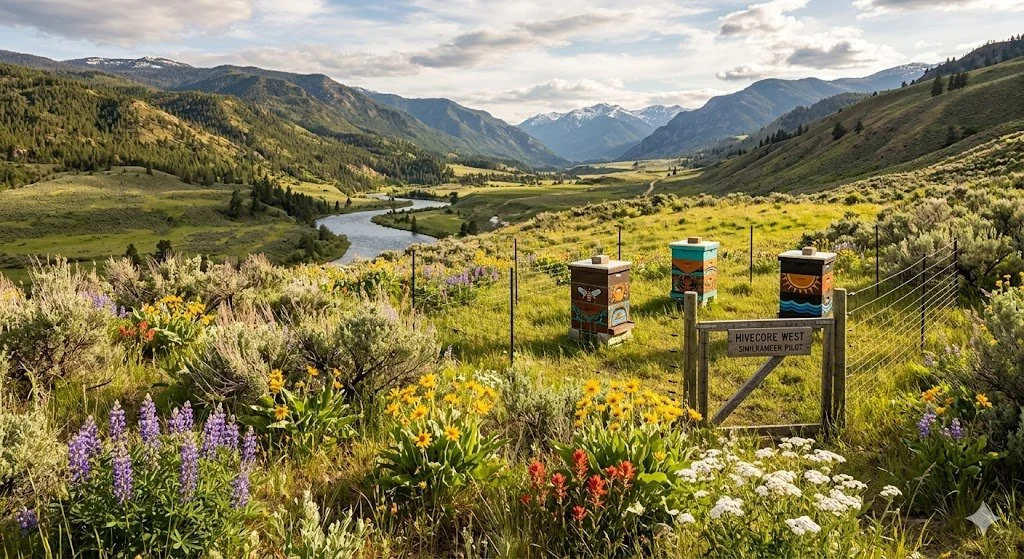
A wide-angle landscape of the Similkameen Valley near Princeton, BC, showing the HiveCoreWest pilot apiary. Four honeybee hives, hand-painted with local indigenous-inspired art, are secured within a professional solar-powered bear fence amidst native wildflowers and rolling mountains.
Take Action: Partnering with HiveCoreWest
The era of "checking the box" is over. Stakeholders and communities are demanding verifiable proof of restoration. HiveCoreWest provides the infrastructure to turn your environmental promises into Biological Receipts.
1. For Environmental Engineers & Mine Managers
Are you currently planning your 2026/2027 reclamation strategy? Don't wait until the saplings are in the ground to consider your biological audit.
Request a Site Assessment: We provide initial feasibility studies to determine the optimal placement for Sentinel Hives within your reclamation zones.
[Button: Book a Technical Consultation]
2. For ESG & Sustainability Officers
Differentiate your corporate social responsibility reporting with data that people can actually see and taste.
Download our Protocol Overview: Learn how the 3H Standard integrates into modern ESG reporting frameworks to provide "Ground-Truth" transparency.
[Button: Download the Sentinel Protocol White Paper]
3. For Community Partners & Landowners
We are currently expanding our Regional Baseline Network in the Similkameen and Okanagan regions.
Host a Sentinel Hive: If you own land adjacent to industrial zones and want to contribute to our regional health database, we want to hear from you.