

The Honeybee as a Forensic Sensor: Establishing the Biological Receipt
Executive Summary
Traditional environmental monitoring is fundamentally limited. Standard "point-in-time" soil and water sampling only captures a static snapshot of an active landscape, often missing critical fluctuations, atmospheric deposits, and trace contaminants. At HiveCoreWest, we deploy a superior, continuous solution: Sentinel Field Networks. For over 30 years, I have stewarded honeybee systems. Today, we utilize that mastery to transition the hive from an agricultural tool into a high-fidelity forensic data-stream. This process establishes the Biological Receipt—a definitive record of ecosystem recovery for heavy industry and agriculture.
Chapter 1: The Foundation – Mastering the Sensor via the 3H and LISTEN Standards
My journey toward industrial biomonitoring began thirty years ago, not in a laboratory, but in the field. Mastery in this craft is an endurance sport; it requires thousands of hours of observation. Out of this commitment, I developed two non-negotiable protocols to ensure our environmental "sensors"—the bees—are always operating at peak fidelity.
The 3H Matrix: Happy, Healthy, Heavy This is our primary quality control. We ensure every Sentinel colony is Happy (low stress/aggression), Healthy (disease-free), and Heavy (resource-rich). A 3H-certified colony is not merely surviving; it is thriving. This state of high-vitality ensures robust foraging behaviors and stable demographics, which are required for consistent, high-fidelity data collection across the site. If the sensor is broken, the data is compromised.
The LISTEN Protocol This is our real-time diagnostic tool. A thriving super-organism has a specific acoustic resonance and metabolic weight profile. We "listen" to the hive to read the immediate condition of the ecosystem. A sudden drop in weight or a specific spike in bio-acoustic stress signals an environmental fluctuation or a floral dearth before a human sampler could ever detect it. We calibrate the bees so they can tell us the truth about the land.
Chapter 2: The Method – Calibrating the 3-Kilometer Forensic Radius
Traditional sampling techniques suffer from a lack of scale. A human technician might take a soil core every hectare or a water sample once a quarter. This approach misses the continuous atmospheric deposits, subtle groundwater migrations, and seasonal floral shifts that are critical for de-risking a reclamation site.
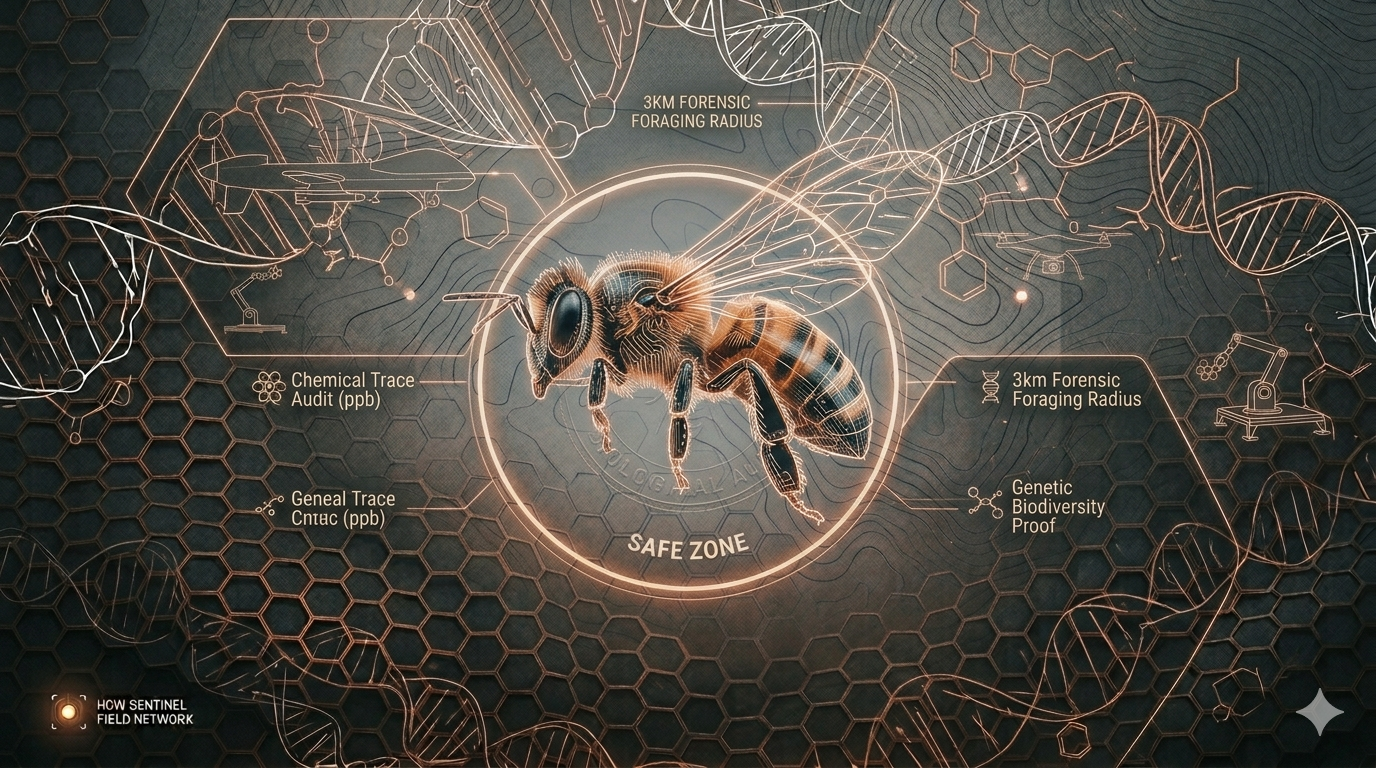
We calibrate a Sentinel Field Network to exploit the 3-Kilometer Forensic Radius. A single colony performs thousands of data-collection sorties every day, covering a foraging area of roughly 2,800 hectares (7,000 acres). As they forage, these microscopic scouts interact with every flowering plant, soil surface, and water source, effectively "air-sampling" the environment 24/7.
The colony acts as a biological concentration mechanism. It brings the landscape’s "Ground Truth" back to the hive, depositing environmental signatures into the honey, the propolis (tree resin), and especially the beeswax. Because wax is lipid-soluble, it functions as the system’s permanent chemical memory, storing years of environmental data that we can then unlock.
Chapter 3: The Output – Establishing the Biological Receipt through Forensic Audits
When a project transitions to Phase 2 (Mobilization), the focus shifts from the Beekeeper to the Data Analyst. While I oversee the Living System, I coordinate with specialized laboratories to produce the final, defensible data. We translate complex biological activity into a clear Biological Receipt using two primary data streams.
I. Chemical Integrity via ICP-MS Trace Analysis We analyze wax and propolis samples using Inductively Coupled Plasma Mass Spectrometry (ICP-MS). This allows us to detect over 20 different heavy metals—such as Lead, Arsenic, Zinc, and Copper—at parts-per-billion (ppb) sensitivity. This is the "Chemical Receipt" that proves whether toxicity mitigation strategies are actually working.
II. Biodiversity Proof via DNA Metabarcoding We use DNA Metabarcoding on collected pollen to produce a complete Genetic Species Inventory. Unlike a human observer who might miss rare or seasonal blooms, the bees find everything. This data provides the "Biological Receipt" of floral succession, proving with genetic certainty that native biodiversity is returning and the ecosystem is reaching maturity.
“In the field of land reclamation, the greatest challenge isn’t just planting seeds—it’s proving they’ve actually taken hold and are functioning as a resilient ecosystem. Traditional soil and vegetation sampling is labor-intensive and provides only a fragmented view of site health.
”By utilizing honeybees as a bio-indicator, we aren’t just looking at the plants; we are analyzing the active biological transactions of the entire landscape. The DNA Metabarcoding of pollen and ICP-MS analysis of wax provide a high-resolution ‘Biological Receipt’ that is technically superior and more cost-effective than traditional manual audits. It’s the difference between a single snapshot and a 24/7 security feed of environmental recovery.”
Chapter 4: The Value – De-Risking through Forensic Certainty
For industry stakeholders, the ultimate goal of environmental monitoring is de-risking. Regulatory agencies and ESG (Environmental, Social, Governance) directors demand proof of performance, not anecdotal stories.
A Sentinel Field Network doesn't just ask if your land is recovering; it provides the forensic data that proves it. By deploying our specialized living sensors, you shift your narrative from defensive environmental compliance to proactive environmental leadership. We don't just provide beekeeping; we provide forensic certainty and the Certification of Recovery.
Connect. Explore. Sustain.